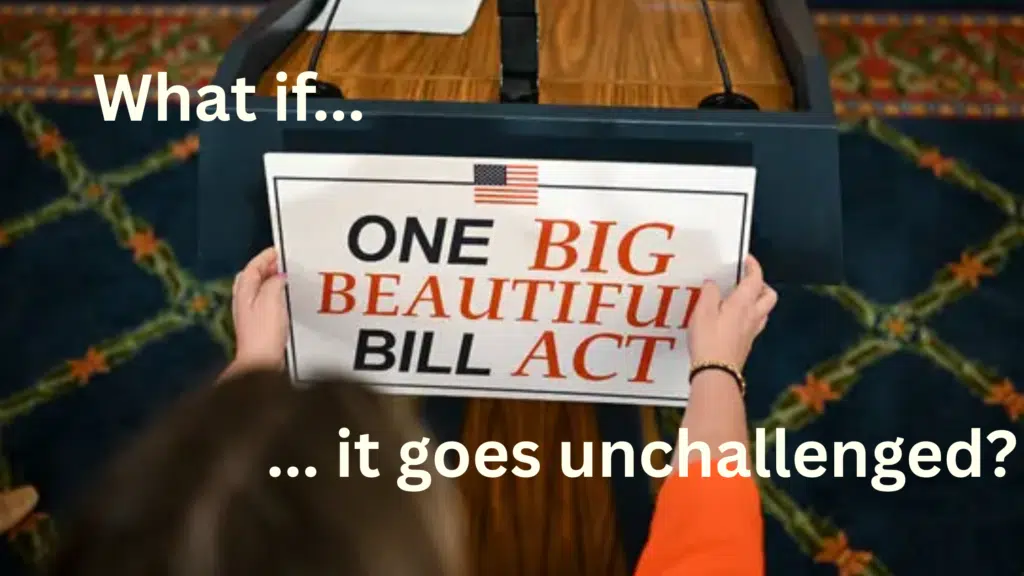
This was written with the help of AI. I asked Claude to create a world where The Big Beautiful Bill along with the current “desired” immigration reform was left unchallenged. I had Claude research the bill and immigration reform with zero interpreptations or opinions from me. I did hawever tell Claude to make the main character, Karen, a middle aged Christian Evangelical who was coming to terms with what it means to love your neighbor. This is that story.
The morning alarm chimed at 5:47 AM, same as always. Karen pressed her palm against the biometric scanner beside her bed, confirming her identity for the daily Citizen Compliance Report. Green light. Good standing. Another day of peace.
She padded to the kitchen in her slippers, the familiar weight of her ankle monitor barely registering anymore. Everyone had them now—part of the Enhanced Border Security Act of 2027. “If you have nothing to hide,” Pastor Mike had said from the pulpit, “then you have nothing to fear.” The small device tracked movement, purchases, and social interactions. It was for everyone’s safety.
The coffee maker activated automatically when it detected her proximity. Premium roast—her reward for maintaining a Perfect Citizen Score for eighteen consecutive months. Karen smiled as steam rose from her favorite mug, the one emblazoned with “Blessed are the Peacemakers” in flowing script.
She was good at keeping the peace. Always had been.
The wall display flickered to life, showing the morning briefing. Deportation numbers scrolled across the bottom: 47,000 this week alone. “A new record,” announced the cheerful anchor. “Thanks to facilities like Gator Grove in Texas and Serpent’s Den in Arizona, our nation continues its return to order and prosperity.”
Above the immigration ticker, economic headlines blazed: “DEFICIT HITS $35 TRILLION—ECONOMISTS WARN OF FISCAL CRISIS.” Karen stirred sugar into her coffee and changed the channel. What was the point of worrying about numbers she couldn’t change anyway?
Her reflection caught in the kitchen window—a tired woman of fifty-three with graying roots she could no longer afford to touch up. Not since the Medicaid work requirements kicked in two years ago. As a government contractor, Karen made too much to qualify for assistance, but after David lost his job at the solar panel factory—one of 200,000 clean energy workers laid off when the tax credits disappeared—every dollar counted.
The factory closure had devastated their Texas town. Fifteen years of growth, good jobs, hope for the future. Gone in eighteen months. The official reason was “market correction following subsidy elimination.” Everyone knew what that meant: the Big Beautiful Bill had pulled the rug out from under an entire industry.
But Karen didn’t think about that. Thinking about it made the coffee taste bitter.
She checked her tablet for the day’s assignments. As a forensic accountant for the Department of Homeland Security, she analyzed financial records of detainees to identify “networks of illegal support.” It was important work, Pastor Mike reminded the congregation. Biblical work. “Render unto Caesar,” he’d say, “and unto God the things that are God’s.”
The work paid well now—$85,000 annually, plus overtime that was tax-free up to $25,000 under the new provision. Karen worked plenty of overtime these days, sometimes sixty-hour weeks. Had to, with David bringing home only $180 a week in unemployment benefits. The extra $18,000 in untaxed overtime helped, but it meant she barely saw her family anymore.
The first case file loaded: Maria Santos, 34, elementary school teacher. Detained during a workplace raid in Phoenix. The algorithm had flagged unusual cash deposits—$200 every month for three years.
Karen’s fingers hesitated over the keyboard. She’d seen this pattern before. Parents paying for their children’s school supplies. Teachers buying classroom materials with their own money, getting small reimbursements from grateful parents who couldn’t afford the supplies themselves but wanted their children to have books and crayons.
She knew because she’d done it herself, back when she taught second grade. Before the federal court restrictions made it impossible to challenge the new education funding formulas that gutted public school budgets.
Her cursor hovered over the classification dropdown. “Suspicious Financial Activity” would trigger an automatic five-year extension of detention. “Routine Teacher Expenses” would clear Maria for deportation processing within sixty days.
Sixty days to say goodbye to her life.
Karen selected “Suspicious Financial Activity” and moved to the next file.
What choice did she have? The algorithm was rarely wrong. And anyway, these cases weren’t really her decision. She was just documenting what the system had already determined. Following orders. Keeping the peace.
The next file showed a photograph that made her breath catch: Eduardo Martinez, 45, construction supervisor. The man had kind eyes and calloused hands. His financial records showed regular transfers to an account in Mexico—$500 monthly for six years.
Karen recognized this pattern too. Support for elderly parents. Her own mother had needed similar help before she died—medical bills that Medicaid no longer covered after the work requirements excluded her from the program. Mom had been sixty-eight, too young for Medicare, too sick to work the required eighty hours a month.
She’d died in the emergency room, unable to afford her insulin.
But the algorithm flagged international transfers as potential money laundering. Karen clicked through Eduardo’s personal files. Two daughters, honor students. Wife worked at the local hospital as a nurse—until the hospital closed six months ago. Healthcare facilities across rural America were shuttering as Medicaid patients disappeared and federal funding dried up under the fiscal constraints.
Her phone buzzed with a text from her own daughter: “Mom, can you help with Emma’s school fees? Jake’s hours got cut again. And the clinic says we need to pay $2,000 upfront for Emma’s asthma inhaler now that we lost insurance.”
Karen stared at the message. Her son-in-law Jake had been working construction on the new detention facilities—one of the few remaining jobs that paid decent wages. But even that work was uncertain. Private prison companies got the big contracts, and they preferred workers without questions about what they were building.
The family had lost their health insurance when Jake’s previous employer—a small renewable energy company—went bankrupt after losing all federal contracts. Under the new tax structure, Jake’s family would actually owe money at tax time despite earning barely $35,000 annually. The SALT deduction increase only helped families wealthy enough to itemize.
She typed back: “Of course, sweetheart. Love you.”
Then she returned to Eduardo’s file and selected “Suspicious Financial Activity.”
The weight in her chest grew heavier.
By lunch, she’d processed thirty-seven cases. Thirty-seven lives reduced to suspicious algorithms and checked boxes. She ate her sandwich in the break room, listening to colleagues discuss weekend plans. Normal conversations in an abnormal world.
“Did you hear about the new facility in Louisiana?” asked Janet from Immigration Compliance. “They’re calling it Python Paradise. Brilliant marketing.”
“Much better than Alligator Alcatraz,” agreed Tom from Border Analysis. “Though I have to say, the deterrent effect has been remarkable. Applications for asylum are down ninety-seven percent.”
Tom looked tired. His own daughter had lost her teaching job when the local school district consolidated—budget cuts from the federal funding formula changes. Now she worked at Walmart for $12 an hour with no benefits.
“Well, when people know they’re going to facilities named after dangerous animals,” Janet laughed, “they think twice about coming here illegally.”
Janet’s laugh sounded forced. Her husband’s auto parts store had closed last year when the factory that employed most of their customers moved to Mexico—ironically seeking the cheap labor that American policies had driven south.
Karen nodded along. Kept the peace.
Around them, the break room buzzed with quiet desperation disguised as normalcy. Everyone knew someone who’d lost their job to the energy transition collapse. Everyone knew someone who’d lost healthcare coverage. Everyone knew someone who couldn’t afford basic necessities despite the promised tax relief that somehow never materialized for families like theirs.
But no one talked about it directly. Complaining about government policies could affect your Citizen Score.
That afternoon brought a case that made her hands shake: Esperanza Morales, 16, honor student. Detained during a school pickup. The girl’s mother had been picked up in a raid two months earlier and was currently held at Viper Valley in New Mexico. Esperanza had been living with her aunt, working part-time to help pay rent.
The financial records showed exactly what Karen expected: small cash deposits from babysitting, lawn work, cleaning houses. The desperate scrambling of a child trying to survive while her mother sat in a cage surrounded by desert and poisonous snakes.
Karen’s own granddaughter was sixteen. Emma, with her bright smile and dreams of veterinary school. Emma, who now worked twenty hours a week at a fast-food restaurant just to help her parents pay rent. College was becoming a distant dream as tuition skyrocketed and student aid programs faced budget cuts.
The classification dropdown seemed to mock her. Karen’s finger trembled over the mouse.
She thought about Pastor Mike’s sermon last Sunday: “Christ calls us to love our neighbors as ourselves. But he also calls us to respect authority. To trust that God works through our leaders to restore prosperity.”
Pastor Mike always emphasized the prosperity part. His church had received a substantial tax exemption under the new religious liberty provisions—money that helped him maintain his comfortable lifestyle while his congregation struggled with medical bankruptcies and foreclosed homes.
She thought about her Perfect Citizen Score. The premium coffee. The small privileges that made life bearable in a world where basic necessities had become luxuries for families like hers.
She thought about Emma, and what would happen if Karen’s score dropped. If she lost her security clearance. If David’s unemployment benefits were suspended because his wife was flagged as “unreliable.”
The unemployment office had already warned David twice about “insufficient job search activity.” Never mind that the clean energy sector that employed him for fifteen years had been systematically dismantled. Never mind that construction jobs required Citizen Scores he couldn’t achieve. Never mind that retail work paid so little that taking it would disqualify him from unemployment without providing enough income to survive.
Karen selected “Suspicious Financial Activity” and immediately closed the file. She couldn’t look at Esperanza’s photograph anymore.
When she got home that evening, David was sitting at the kitchen table with a stack of bills and a letter from the IRS. His face was gray with exhaustion.
“The mortgage payment bounced,” he said without looking up. “And Emma needs money for her college applications. But look at this—we owe $3,200 in taxes.”
Karen stared at the letter. Despite David’s unemployment and their reduced income, they owed money. The tax cuts that were supposed to help middle-class families somehow didn’t apply to them. The SALT deduction increase was meaningless when you could barely afford to itemize. The estate tax changes would never benefit people who’d never own estates.
Meanwhile, Karen’s wealthy clients—the ones whose cases she processed in her private accounting practice on weekends—were saving tens of thousands annually.
“Maybe I should apply for one of those construction jobs,” David said quietly. “The ones building the new facilities. They’re hiring anyone now, and the pay is good.”
Karen looked at her husband—really looked at him. When had he gotten so thin? When had his shoulders started curving inward like he was trying to disappear?
“David, you can’t. Those places…” She stopped herself.
Those places were necessary. That’s what she told herself every day. Necessary for order. For security. For prosperity. The economic boom from the detention industry was creating jobs. Private prison stocks had tripled, creating wealth that would trickle down eventually.
But their coffee had started tasting like ash weeks ago. And their neighbors kept disappearing—not just undocumented immigrants, but longtime residents whose paperwork had expired, whose names sounded foreign, whose skin was too dark for comfort.
Through the window, she could see their neighbor’s house—the Garcías, who’d lived there for eight years until last month. Roberto had worked at the solar factory with David. Maria had taught Sunday school at their church. Their son played soccer with the youth group.
They’d been taken during a “routine verification” sweep. The house now stood empty, a foreclosure notice taped to the door. Another family destroyed by policies that were supposed to make America prosperous again.
That night, Karen lay awake listening to David’s breathing beside her. In the darkness, Esperanza’s young face floated behind her eyelids. Maria Santos’s teacher hands. Eduardo’s kind eyes.
Her phone buzzed with an encrypted message—something she’d never seen before. The sender was listed as “Friend.”
“They’re coming for the teachers next. Then the nurses. Then anyone who’s ever helped. The list is longer than you think. Your name might be on it. The courts can’t stop them anymore.”
Karen’s heart pounded. She should report this immediately. Suspicious communications were a federal crime under the Digital Security Act. And with the new restrictions on federal courts, there was no appeal process for digital crimes.
Instead, she deleted the message and stared at the ceiling until dawn.
The next morning’s briefing showed new footage from Cottonmouth Creek in Florida—the newest facility, built in a swamp so remote that GPS signals barely reached it. The reporter smiled as she described the “state-of-the-art deterrent features” and “complete isolation from outside influence.”
The economic segment followed: “Job creation in the detention industry continues to offset losses in renewable energy, with private contractors reporting record profits. However, consumer spending remains sluggish as families adjust to the new tax structure.”
Karen watched a brief shot of the detainees: families in orange jumpsuits, children clinging to adults, all of them looking directly into the camera with the same expression she’d seen in every case file.
Terror. Pure, helpless terror.
Her Perfect Citizen Score notification chimed: 987 points out of 1000. Excellent standing. Premium benefits maintained.
She looked at the notification, then at the screen showing children in cages surrounded by water moccasins and alligators. Children who looked like Emma. Families who looked like the Garcías.
Families who could be hers, if David’s last name and Karen’s dropping score caught the wrong attention.
For the first time in five years, Karen turned off the display.
She sat in silence with her coffee, thinking about Esperanza Morales. About her own granddaughter. About the verse embroidered on a pillow in her living room: “Love your neighbor as yourself.”
When had she stopped seeing the people in her case files as neighbors?
When had she started seeing them as anything other than children of God?
The weight in her chest cracked open, and Karen began to weep. Not the quiet tears she’d shed in private moments, but deep, wrenching sobs that came from some place she’d locked away years ago.
She wept for Maria Santos, whose only crime was loving children enough to buy them school supplies.
She wept for Eduardo Martinez, whose only crime was taking care of his aging parents.
She wept for Esperanza Morales, whose only crime was existing while brown in America.
She wept for her mother, who died because medicine became a luxury.
She wept for David, ground down by an economy that had abandoned workers like him.
She wept for Emma, whose dreams were shrinking with each passing month.
And she wept for herself—for the woman she’d become by choosing comfort over courage, compliance over compassion.
Her tablet chimed with new case files. Seventeen more lives waiting for her decision.
Karen stood up slowly, her ankle monitor beeping as it registered the movement. She walked to her home office and opened the first file: Roberto Aguilar, 52, pastor of a small Baptist church. Detained for providing food to families during immigration raids.
A pastor. Like Pastor Mike, who told them God worked through authority and that prosperity was a sign of divine blessing.
Unlike Pastor Mike, who had apparently forgotten that sometimes God’s authority contradicted Caesar’s. And that Jesus had fed the hungry without checking their documentation.
Karen’s finger hovered over the classification dropdown. For the first time in five years, she really looked at the photograph. Roberto had gentle eyes and work-worn hands. He looked like someone who would comfort a crying child, who would sit with the dying, who would feed the hungry without asking about their papers or their scores or their worthiness.
He looked like Jesus.
The realization hit her like cold water: she had been classifying Jesus as a security threat for five years. While her own community crumbled around her, while families lost healthcare and jobs and homes, while children went hungry in the richest nation on earth, she had been protecting a system that crucified Christ daily.
Karen selected “Routine Pastoral Activities” and felt something shift inside her chest. The weight was still there, but it felt different now. Less like a stone, more like an anchor.
She moved to the next file, and the next, and the next. With each “Routine” classification, the weight transformed. It wasn’t disappearing—it was becoming something she could carry. Something that grounded her instead of crushing her.
By noon, she had cleared forty-three cases for immediate deportation processing instead of extended detention.
By evening, her Perfect Citizen Score had dropped to 923.
By the end of the week, it was 847.
The coffee had switched to standard blend. Her premium parking spot was revoked. Small penalties for unreliable classification patterns.
Karen didn’t care. For the first time in years, she could taste her coffee again.
The encrypted messages came more frequently now. Names of people who needed help. Safe houses. Legal aid networks. A whole underground church she’d never known existed, following the same Jesus she’d claimed to serve while building the very cages He would have broken open.
Her husband noticed the change. “You seem different,” he said one evening as they walked around their neighborhood. Past the García house, still empty. Past the Martinez apartment, windows dark. Past the shuttered solar panel factory where David had once built clean energy infrastructure.
Past the new construction site where Python Paradise II was rising from Texas soil.
“I stopped lying to myself,” Karen said.
David was quiet for a long moment. Then: “What are we going to do?”
Karen looked at him—her partner of twenty-eight years, who’d lost his career to policies that claimed to create prosperity while crushing working families, who’d watched his community disappear one raid at a time, who’d grown gray and thin trying to keep his head down and survive in an economy that had abandoned people like them.
“We’re going to remember who we’re supposed to be,” she said.
That night, she submitted her resignation letter. In the morning, she would join the network of teachers and nurses and pastors and accountants who had decided that following Jesus meant more than following orders. Who understood that loving your neighbor meant more than protecting your Citizen Score.
Her Perfect Citizen Score would plummet. They might lose the house. David might lose his unemployment benefits. They might end up in one of those facilities themselves.
But Karen had finally learned the difference between keeping the peace and keeping silent.
And sometimes, breaking your silence was the most peaceful thing you could do.
The coffee maker activated as she passed it, but she didn’t stop for her morning cup. She had work to do—the kind of work that wouldn’t show up in any government database.
The kind of work that mattered.
Outside her window, the sun was rising on a world she’d helped create through her willful blindness. A world where tax cuts for the wealthy coincided with healthcare losses for the poor. Where prosperity promises masked the systematic destruction of working communities. Where Christian nationalism had replaced the radical love of Christ.
But today, Karen could finally see clearly.
Today, she chose to look.
Pingback: Christian Nationalism vs. Jesus: Finding Faith Beyond Political Power
Pingback: How Religious Trauma Happens - Grace In The Margins
Comments are closed.