I’m writing this on a day when dinner was buttered noodles.
Not a three-day braise. Not fresh-milled sourdough. Buttered noodles, because I work full time and by 6pm the toddler was past it and so was I.
I want to tell you that, before I tell you anything else. Because I’m about to write several thousand words about biblical womanhood, and I don’t want you to read them through the filter of someone who has it together. I don’t. Some nights we eat something that took three days to make from ingredients I grew in my own garden. Some nights it’s a pizza at 11pm. Both of those nights, I am feeding my family. Both of those nights, I am doing my best. I have no shame about either one.
Here’s what I do have: a master’s degree in Biblical Studies, more than ten years in ministry, and twenty years of personal history with what happens when a theological framework meets a real marriage and a real abuser who benefits from it.
So when people talk about biblical womanhood — and right now, with the tradwife movement flooding every social media platform, a lot of people are talking about it — I have thoughts. Grounded ones. Hard-earned ones.
Let me share them.
Where “Biblical Womanhood” Actually Came From
The phrase gets spoken in churches as though it arrived with the canon of Scripture. As though questioning it is the same as questioning God.
But the formal theological system behind modern “biblical womanhood” was largely constructed in 1987 — at a meeting in Danvers, Massachusetts, where the Council on Biblical Manhood and Womanhood was founded as an explicit response to second-wave feminism. The term “complementarian” — the belief that God designed men and women for hierarchically distinct roles in marriage and church — was coined the following year at a breakfast meeting during an Evangelical Theological Society conference.
This is not ancient. The founders knew it. In the 1991 preface to Recovering Biblical Manhood and Womanhood, John Piper and Wayne Grudem described their project as a “new vision” intended to correct “previous mistakes.” They were building something. Not recovering something.
Sociologist James Davison Hunter called the complementarian family ideal something with “no real historical precedent in Christendom or anywhere else” — a “hypersentimentalized variant” of 1950s American domesticity.
I’m not saying new ideas are automatically wrong. I’m saying we should examine what we’ve inherited rather than assume it’s always been this way.
The Imago Dei
Before we get into specific texts, I want to name a theological conviction that I think changes the entire conversation — and almost never gets the attention it deserves.
Genesis 1:27 says that God created human beings — male and female, both — in God’s own image. The imago dei. Not a partial image. Not a derivative one. The same image, without qualification, without gender distinction in the text.
This is the foundation of human dignity in Christian theology. It’s why every person has worth, why every voice matters, why no human being can be reduced to a function or a role. I’ve written more about what the imago dei means in practice here.
If women bear the full image of God — equally, completely — then any theology that systematically restricts women’s voices, limits women’s agency, or requires women’s financial dependence has to answer for that starting point. It can’t just skip Genesis 1.

I find myself drawn to the Quaker witness here. Quakers have practiced for centuries what many churches only preach in theory: that every person equally bears the Spirit, equally hears from God, equally belongs at the center of worship. Their meeting has no elevated pulpit, no single authoritative human voice. That is not a preference. It is theology lived out in practice. And that same conviction has moved Quakers consistently toward justice — abolition, women’s suffrage, peacemaking — because when you truly believe in the imago dei, you cannot stay comfortable while some image-bearers are being diminished.
My husband is Adventist. I am not. Our theologies don’t always line up perfectly, and we’re building a marriage on honest conversation and genuine mutual respect rather than theological uniformity. We disagree and choose each other anyway. I find that the Adventist conviction about the body as a holy temple — that what we eat, how we rest, how we care for physical life is itself an act of worship — resonates deeply with something I’ve been moving toward for years. Slowly moving away from processed food isn’t a trend for me. It’s a small daily act of believing that these bodies and this earth are sacred. The whole foods, the garden, the sourdough — those come from that conviction.
But I won’t pretend we have a perfect marriage. We don’t. What we have is the kind of marriage where both people bring their full selves to the table, hold their convictions, and love each other through the disagreements.
That, I think, is closer to what Scripture actually describes.
So, What Does the Bible Says About Women?
When you read Scripture without a predetermined framework telling you what women are allowed to do, you find them doing things that should surprise anyone raised on the standard “biblical womanhood” curriculum.
Deborah (Judges 4–5) holds simultaneous civil, military, and religious authority in Israel. She commands generals. She prophesies. She composes and leads worship. The text registers no controversy about her gender. She governs for approximately sixty years and calls herself “a mother in Israel” — one of the highest honors in all of Scripture.
The Wise Woman of Tekoa (2 Samuel 14) is sent to King David specifically because of her wisdom. Joab, David’s military commander, recruits her to construct a parable sophisticated enough to change the king’s mind about Absalom — and it works. David, the greatest king in Israel’s history, is persuaded by her argument. She’s not a prophet, not a judge, not holding any formal office. She is simply a woman known for her wisdom, and the most powerful man in Israel needs it.
Huldah (2 Kings 22) is a prophet in Jerusalem during the reign of King Josiah. When the Book of the Law is discovered in the temple — a moment of national crisis — Josiah doesn’t send his priests to just any available voice. He sends them to Huldah. She authenticates the scroll, delivers God’s word to the king, and shapes the most significant religious reform in Judah’s history. Isaiah was alive. Jeremiah was alive. Josiah chose Huldah.
Priscilla (Acts 18, Romans 16) corrects the theology of Apollos — a learned man, mighty in the Scriptures — and does it well enough that he becomes one of the early church’s most significant teachers. Paul calls her his synergos: co-worker, the same term he uses for his male ministry partners.
Phoebe (Romans 16:1–2) is called diakonos — the same Greek word Paul uses for himself and for Christ — and prostatis, a leadership term. She likely carried the letter of Romans to the Roman church, which means she was the first person to publicly read and interpret Paul’s most significant theological letter.
The Proverbs 31 woman opens with the Hebrew phrase eshet chayil — warrior woman, drawn from the same military vocabulary used for Gideon and David’s elite soldiers. She buys real estate from her own earnings, runs a manufacturing and wholesale business, teaches publicly, and has her works praised at the city gate — the civic space where men conducted public life. She is not a woman confined to the home. She is in every sphere available to her and celebrated for it. I go deep on this in The Proverbs 31 Woman Wasn’t Who You Think She Was.
These are not exceptions. They are normative examples, presented in Scripture without apology.
The Hard Passages — Read in Context
The difficult texts deserve honest engagement, not dismissal and not flattening.
Ephesians 5:22 — “wives, submit to your husbands” — does not contain a verb in the earliest Greek manuscripts. The verb is borrowed from verse 21: “submit to one another out of reverence for Christ.” You cannot read verse 22 honestly without verse 21. When you read what the Bible actually says about submission in marriage — and wrestle honestly with whether a wife is called to obey her husband — the full picture changes significantly.
Paul’s letters were written into Roman imperial households where the subordination of wives, children, and enslaved people to the male head was assumed social order. Paul works within that structure while quietly subverting it toward the gospel’s more radical logic — addressing both parties in every relationship, giving each dignity as moral agents. The trajectory of his argument moves toward mutuality. We recognize this when it comes to slavery. We’ve been slower to recognize it when it comes to gender.
This is not liberal theology. It is careful reading.
When Theology Meets Real Life

I want to be direct here, because this is not abstract to me.
I stayed in my first marriage for twenty years. Ten of those years my husband was active duty Army. We spent all of that time in El Paso. I had community. I had pastors. Before we even got to El Paso, I sought one out and told him directly — I think I should leave my husband. He told me I was wrong.
It happened again in El Paso. Same answer.
What I find both darkly funny and genuinely infuriating, looking back, is that three different bankers told me otherwise. People who called over those years about missed payments and mismanaged accounts — strangers on the phone, looking at nothing but the numbers — told me I should leave him.
The ones who could see the money gave me better advice than the church did.
For years I had no framework for what financial abuse even was. The theology I had absorbed told me that good wives trust their husbands, submit to their leadership, and don’t turn financial chaos into a bigger deal than it needs to be. So I fixed each crisis, handed the finances back to him, and told myself this time would be different.
I was taking my kids to food pantries while he spent bill money on hobbies. I was checking the bank account mid-grocery-shop because money had a way of disappearing between the parking lot and the checkout lane. When he deployed, I discovered he had quietly stopped paying bills months earlier — car insurance, utilities, credit cards — without telling me. I scrambled to keep us afloat on an emergency loan.
Years later, I found out he had opened a credit card in my name and maxed it out. I figured out it was him three days before I had to stand in front of a judge. When I confronted him, it was like watching a mask fall away. He knew. He had always known.
I left after twenty years. My three older children — one son and two daughters — are young adults now. We co-parent. I have rebuilt.
The theology I was handed did not protect me. It kept me from protecting myself. That is not a minor footnote. That is what happens when a framework that removes a woman’s agency meets an abuser who knows how to use it. You can read more about that in When God Leads You Out, Not Through and in the financial abuse piece here.
When Theology Becomes Policy
This is where I have to say something that might feel like a detour but isn’t.
The theology of female submission doesn’t stay in the marriage. It never has. The same convictions about women’s proper sphere — home, family, deference to male authority — that shaped what I was taught in church are showing up right now in legislation.
The SAVE Act, currently being pushed through Congress, would require proof of citizenship showing your full legal name to register to vote. On the surface that sounds straightforward. But roughly 79% of married women take their husband’s last name when they marry — which means approximately 69 million women in this country have a birth certificate that no longer matches who they are. Under the SAVE Act, they would face additional documentation requirements, additional costs, and additional bureaucratic hurdles that men simply don’t face. The Preamble’s analysis of this legislation traces the logic directly back to the anti-suffrage movement, where the legal concept of “coverture” erased a married woman’s independent identity entirely — subsuming it into her husband’s.
That logic never fully went away. Defense Secretary Pete Hegseth has expressed support for “household voting,” in which the husband casts the vote for the family. The 2024 Republican National Convention featured a speaker who publicly called for “bringing back household voting” and wrote that in a “Godly household, the husband would get the final say.”
This is complementarian theology with a ballot box.
When we teach women that their identity is properly subsumed into their husband’s — that his authority is God’s design, that her deference is her faithfulness — we are not just shaping marriages. We are shaping the conditions under which legislation like the SAVE Act can be passed with a shrug. The domestic and the political are not separate spheres. They never were. The women who are being told to stay home and let their husbands lead are the same women being told, functionally, that their vote is redundant.
The imago dei demands better than this. Every image-bearer gets a voice. Every image-bearer gets a vote.
Both Things Can Be True
I want to be careful here, because I’m not making an argument against homemaking, or domestic life, or the beautiful slower rhythms that draw people toward the tradwife aesthetic in the first place.
I love my kitchen. I grow things. I make bone broth and turmeric shots. I let sourdough ferment slowly and I just started a new project of a ginger bug for probiotic homemade soda. I am also working, steadily, to get processed food off our table — because I genuinely believe our bodies are holy and what we feed them matters. Some of that conviction comes from faith. Some comes from my husband’s Adventist theology rubbing up against my own and sticking.
And some nights I order pizza and feel exactly zero guilt about it.
That is the real life of a full-time working mom who loves homemaking and does not always have time to do it. I do both. I hold both. I am not performing either one.
What I will not do is accept a theology that says caring for my family requires surrendering my voice, my financial independence, or my ability to trust my own instincts. I did that once. For twenty years. I know what it costs.
The tradwife movement conflates the aesthetic of intentional domestic life with a theology of female dependence — and then calls the whole package “biblical.” It is not. The Proverbs 31 woman had her own earnings. She made her own decisions. She was praised in public. She was not financially dependent on her husband’s goodwill, and her worth was not contingent on his approval.
You can love your home and own your voice. You can make sourdough and have your own bank account. You can care deeply for your family and still be a full person with convictions that belong to you.
What Biblical Womanhood Really Means
Here is where I land, after seminary and ministry and twenty years of hard-earned theology and a second marriage built on the kind of honest, mutual respect I didn’t have the first time.
Biblical womanhood is not a checklist. It is not a 1987 theological system. It is not an aesthetic.
It is the full, undiminished, image-bearing humanity of women — made to hear from God directly, capable of leading and teaching and building, called to whatever work God places before them, worthy of public honor for everything their hands have done.
It is eshet chayil. Warrior woman.
It is the imago dei — the image of God, stamped on every woman, completely and without qualification.
And it is, I believe, a faith that belongs to each woman personally. Not a theology she performs for someone else’s comfort, or shrinks herself to fit, or abandons piece by piece in order to keep a marriage that was never actually safe.
That version of womanhood is bigger than any linen apron. Wilder than any checklist. And far more interesting than the version most of us were handed.
Read This Next
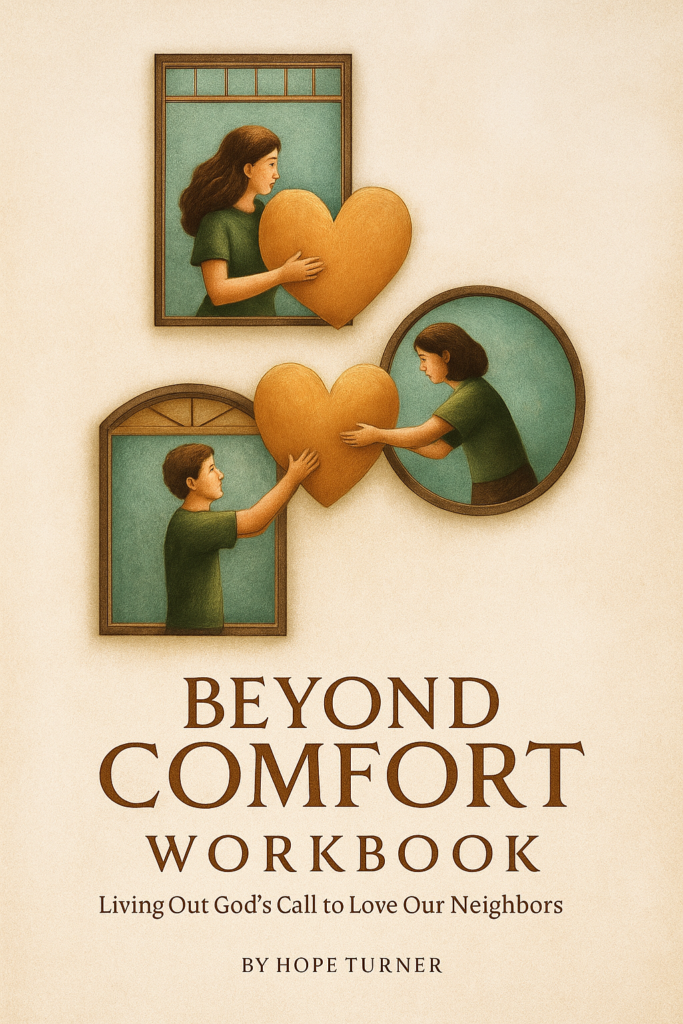
Beyond Comfort
A workbook for loving your neighbors well – even when it’s complicated. For individuals, small groups, and anyone ready to move from good intentions to real action.
Go Deeper: The Full Series
The Proverbs 31 Woman Wasn’t Who You Think She Was — What eshet chayil really means, and why the warrior woman of Proverbs 31 looks nothing like the tradwife ideal. Coming soon.
What Does the Bible Say About Submission in Marriage? — A close reading of Ephesians 5 that starts at verse 21, not verse 22.
Should Wives Obey Their Husbands? — The difference between obedience and mutual submission, and why that distinction matters more than you might think.
Should Husbands Obey Their Wives? — Coming soon.
So You Want to Be a Tradwife? A Biblical Reality Check — The theology, the history, and the financial realities behind the aesthetic.
When God Leads You Out, Not Through — On leaving a marriage, faith, and what Scripture actually says about divorce.
Complementarianism vs. Egalitarianism: What the Bible Actually Says — Coming soon.
Purity Culture and What It Cost Us — Coming soon.
Raising Daughters in a World That Keeps Shrinking Them — Coming soon.
This conversation is most alive when real women bring their real lives into it. I read every comment.