
The panic hits you at 2 AM when you realize you can’t honestly say “amen” to half the prayers in your prayer group anymore.
Or maybe it’s when your eight-year-old asks why bad things happen to good people, and you can’t bring yourself to give her the same answer someone gave you at that age. The answer that never actually satisfied your own questions.
You start wondering: Am I losing my faith, or is something else happening here?
Here’s what I’ve learned through my own wrestling with this question: losing your faith and growing out of easy answers feel remarkably similar. Both involve letting go of what once felt certain. Both leave you feeling spiritually homeless for a while. Both make you question everything you thought you knew about God.
Here’s the difference. One leads you away from relationship with God, and the other leads you deeper into it.
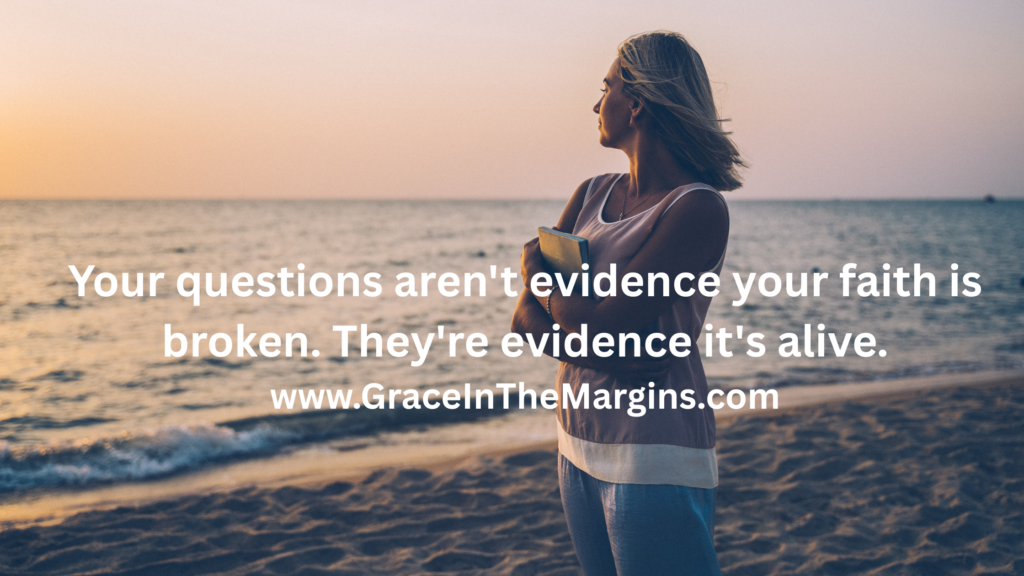
This faith transition isn’t about abandoning belief. It’s about your faith finally getting big enough to hold the complexity of real life.
When Faith Deconstruction Feels Like Faith Loss
I remember the exact moment I thought I was losing my faith.
My daughter had been diagnosed with cancer, my husband left us (mentally and physically checked out of our family), and every prayer felt like it bounced off the ceiling. The God I had packaged so neatly into systematic theology wasn’t showing up the way I expected. The promises I’d built my faith on felt hollow. The easy answers I’d been given about suffering and God’s goodness crumbled under the weight of real life.
For months, I was convinced my faith was dissolving. What I didn’t realize was that only one version of my faith was disappearing. The version that required God to make sense on my terms.
The version that demanded easy answers to complex questions. The version that insisted faith meant never feeling uncertain or afraid. The version that confused spiritual maturity with having all the right theological boxes checked.
That faith needed to die. Not because faith itself is wrong, but because that particular faith was too small for the God I was actually encountering.
What felt like losing my faith was actually the beginning of faith deconstruction – the process of examining and often discarding elements of belief that no longer serve spiritual growth.
What Does It Mean When You’re Outgrowing Your Faith?
When you feel like you’re losing my faith, you might actually be outgrowing:
The faith that demands certainty about everything. Real faith learns to hold mystery without needing to solve it. It’s comfortable saying “I don’t know” about some of life’s biggest questions because it trusts that God is bigger than our understanding.
The faith that requires God to be predictable. Mature faith stops trying to manage God through the right prayers, the right behavior, or the right theological formulas. It learns to engage with a God who is both more loving and more mysterious than we imagined.
The faith that can’t handle complexity. Simple answers work when life is simple. But when you’re wrestling with mental health, struggling relationships, parenting challenges, and global injustice, you need a faith robust enough to hold all of that without breaking.
The faith that demands spiritual performance. You might be discovering that authentic relationship with God looks less like having perfect devotions and more like honest wrestling. Less like never having questions and more like bringing those questions into the light.
This spiritual crisis often signals the beginning of deeper faith, not its end.
How Do You Know If You’re Losing Faith or Growing?
Here’s how to tell whether you’re experiencing faith loss or navigating a faith transition toward spiritual maturity:
Growing faith becomes more curious, not more closed. When faith is maturing, questions don’t threaten it, they deepen it. You find yourself more interested in exploring different perspectives, not because you’re abandoning truth but because you’re discovering truth is bigger than you thought.
Growing faith becomes more compassionate, not more judgmental. As easy answers fall away, you develop more empathy for others who are struggling. Instead of having quick fixes for everyone’s problems, you learn to sit with people in their questions.
Growing faith becomes more integrated, not more compartmentalized. Rather than keeping your faith in a separate box from your work, relationships, and daily decisions, you start seeing how it connects to everything.
Growing faith becomes more honest, not more performed. You stop pretending to be further along than you are. You admit when you’re struggling, when you don’t understand, when you’re angry or disappointed.
The crucial test is this: Are you moving toward authentic relationship with God and others, or are you pulling away from relationship entirely?
If you’re experiencing religious doubt but still longing for deeper connection with the divine, you’re likely growing, not losing.
What Growing Faith Actually Looks Like
I used to think spiritual maturity meant having fewer questions. Now I know it means having better questions.
I used to think it meant being certain about everything. Now I know it means being secure enough in God’s love to admit uncertainty about specifics.
I used to think it meant having all the answers for hurting people. Now I know it means being present with them in their questions.
This isn’t losing faith. This is faith finally growing up.
The faith you’re growing into might look different from the faith you inherited. It might be more nuanced, more comfortable with mystery, more focused on love than being right. It might ask harder questions and refuse simple solutions to complex problems.
That doesn’t make it lesser faith. It makes it stronger faith.
Navigating Your Faith Transition
The space between who you were spiritually and who you’re becoming can feel terrifying. You’re not the person who accepted easy answers anymore, but you haven’t fully become the person who’s comfortable with complex questions yet.
This in-between place is sacred ground. It’s where real growth happens.
Give yourself permission to not have it figured out. The pressure to have clear, confident answers about everything is exhausting and unnecessary. Some of the most profound spiritual truths live in the questions themselves.
Find community that welcomes growth. Look for people who see questioning as faithful, not threatening. Who celebrate when you’re brave enough to admit you don’t understand something rather than pretending you do.
Keep showing up. To prayer, even when it feels awkward. To community, even when you don’t fit neatly into their categories. To scripture, even when you’re reading it differently than you used to. Stepping beyond comfort into the margins is exactly where spiritual growth happens.
Trust the process. Faith that can withstand intellectual challenge, personal crisis, and honest questioning is infinitely more valuable than faith that requires constant protection from difficult realities.
Remember you’re not alone. If you found yourself resonating with the earlier post about struggling with faith in secret, know that this journey of growth is part of that same sacred process.
The Faith You’re Growing Into
The faith you’re growing into won’t give you easy answers, but it will give you something better: the capacity to live with beauty and purpose even in the midst of uncertainty.
It won’t promise that life will make sense, but it will promise that you’re not alone in the mystery.
It won’t solve all your theological questions, but it will teach you to find God in the questioning itself.
You’re not losing your faith. You’re discovering what faith actually looks like when it’s not required to fit into boxes that were always too small anyway.
The God who is big enough to handle your honest questions is also big enough to meet you exactly where you are in this process. Even when where you are feels messy, uncertain, and completely different from where you started.
Especially then.