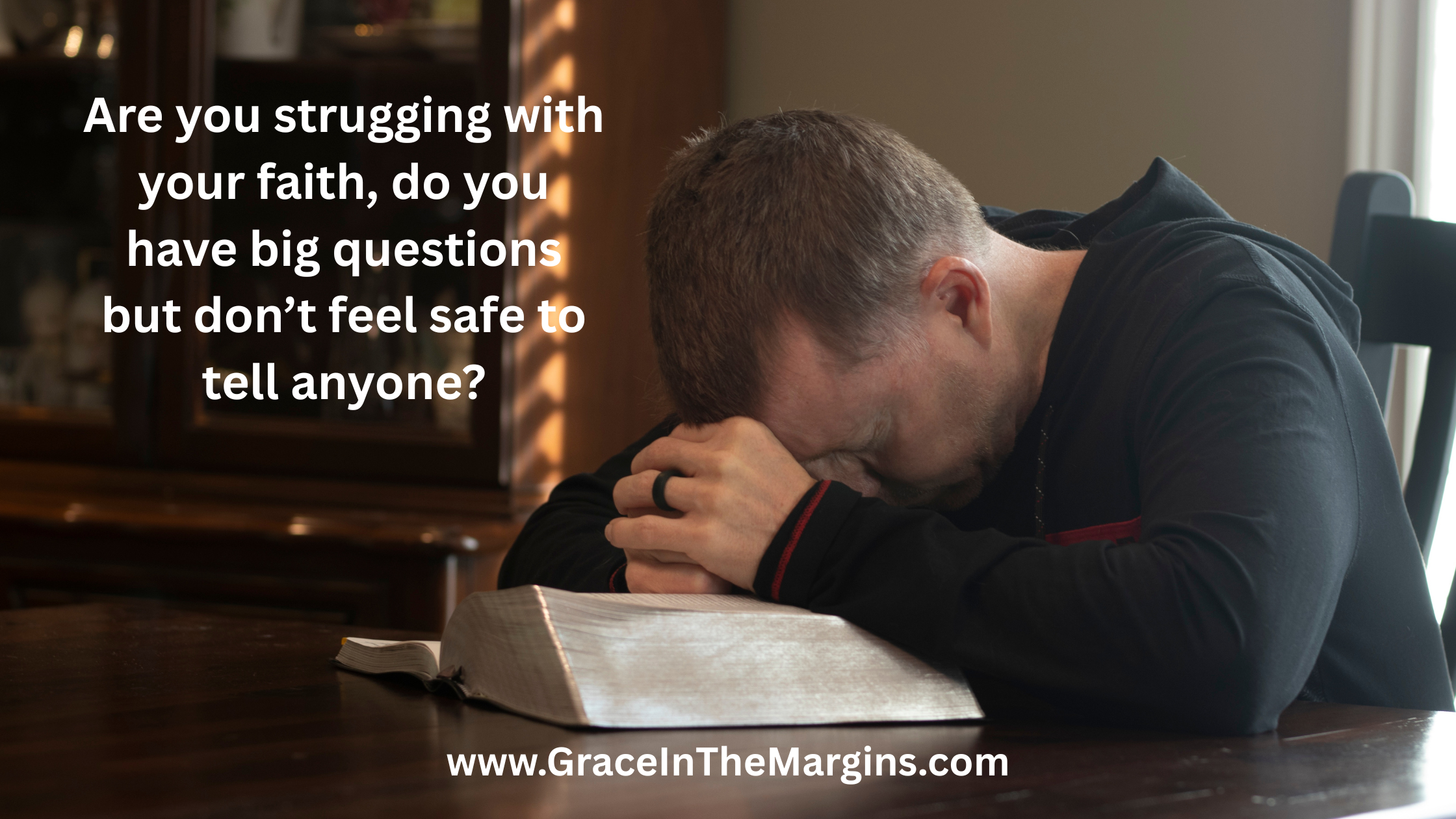
Struggling with faith but afraid to tell anyone? Learn why your questions are sacred and discover practical steps to navigate faith struggles with hope.
You’re headed to church service and dread putting on that smile. The one that says you have it all together, that your faith is solid, that you’re not drowning in questions you can’t voice out loud.
You sit in worship, Bible open on your lap, and feel something stirring deep inside you. Not contentment. Not peace. Something unsettling. Like you’re living in a faith that no longer fits, but you can’t figure out how to say that without sounding like you’re walking away from God entirely.
Maybe you’ve been here for months. Maybe years. The gap between the faith you inherited and the faith you actually hunger for grows wider every week, but the cost of being honest about it feels too high.
You’re not losing your faith. You’re outgrowing a version of it that was never meant to hold you forever.
When Struggling with Faith Feels Impossible
I know this territory because I’ve lived here.
There was a season when my daughter Katie was first diagnosed with cancer, and the God I had neatly packed into a box stopped doing things my way. I closed my Bible, put it to the side, and didn’t pick it up for another year.
The withdrawal was silent but devastating. My family needed me to wrestle with God out loud, to model how faith could hold questions and doubt. Instead, they got my careful performance of having it all together while I quietly fell apart inside.
That silence taught me something crucial about struggling with faith: isolation makes everything worse. When we can’t name what we’re experiencing, when we feel like we’re the only ones asking these questions, the struggle becomes not just about faith but about belonging.
Here’s what I wish someone had told me during those months of struggling with faith and secret doubt: your questions aren’t evidence that your faith is broken. They’re evidence that it’s alive.
Why You Can’t Tell Anyone
The evangelical world I grew up in treated questions like spiritual failures. When you’re struggling with faith, doubt was something to overcome quickly, not something to sit with and explore. The message was clear: good Christians don’t struggle. They trust. They believe. They certainly don’t rage at God or wonder if the whole system needs to be rethought.
So when real struggle hit, I didn’t have language for it. More than that, I didn’t have permission for it.
Maybe you’re feeling that same pressure right now. You look around your church, your small group, your family gatherings, and everyone seems so certain. So settled. Meanwhile, you’re wondering if you can honestly sing another worship song about surrender when you’re not even sure what you’re surrendering to anymore.
The fear is real:
- What if they think I’m losing my faith?
- What if they’re right?
- What if asking these questions leads me somewhere I don’t want to go?
These fears often leave us feeling like we’re not enough – not faithful enough, not strong enough, not certain enough.
But here’s what I’ve learned through my own wrestling and through walking with others in theirs: the questions aren’t the problem. The fear of the questions is.
Your Questions Are Sacred Territory
When Abraham argued with God about Sodom and Gomorrah, when Jacob wrestled with the angel all night, when Job demanded answers from the whirlwind – none of them were politely accepting comfortable answers. They were engaging with the mystery of a God too big for their understanding.
Your struggling isn’t spiritual weakness. It’s spiritual growth.
The difference between destructive doubt and sacred questioning isn’t whether you have questions – it’s what you do with them. Destructive doubt pulls you away from relationship, from community, from hope. Sacred questioning draws you deeper into all three.
When you can’t reconcile the God of love with the God of judgment, that’s not a failure of faith. It’s an invitation to discover a more complex, more beautiful understanding of who God actually is.
When you can’t make sense of why prayer seems to work sometimes and not others, you’re not spiritually immature. You’re honest about the mystery of a relationship that transcends our understanding of cause and effect.
When you wonder if there’s more to following Jesus than avoiding certain behaviors and believing certain propositions, you’re not compromising the gospel. You’re discovering it.

What to Do Right Now
Start small. You don’t need to deconstruct your entire theological framework this week. Begin with one honest conversation – maybe with a journal, maybe with one trusted friend who won’t try to fix you.
Find your people. They exist, I promise. Look for communities that welcome questions, that see doubt as part of faith rather than its enemy. This might mean branching out beyond your current circles, but the relief of finding people who understand is worth it.
Give yourself permission to not know. The pressure to have answers for everything is exhausting and unnecessary. Some of the most profound truths live in the questions themselves.
Keep showing up. To community, to prayer, to whatever spiritual practices still feel life-giving. Struggling with faith doesn’t mean abandoning it. It means staying engaged even when engagement feels messy.
Sometimes that engagement means stepping beyond comfort into the margins where real spiritual growth happens.
Read different voices. Your faith will grow stronger, not weaker, when it can engage with perspectives that challenge and expand your understanding.
The Grace You Need
Here’s what I want you to know as you navigate this season: there’s a grace available to you that’s bigger than your questions, more patient than your timeline, and more interested in your growth than your conformity.
This grace doesn’t demand that you have it all figured out. It doesn’t require that you choose between intellectual honesty and deep faith. It meets you exactly where you are – in the struggling, in the questioning, in the beautiful mess of a life that’s outgrowing its old containers.
This is the grace that helps us distinguish between genuine faith and the counterfeits that often masquerade as Christianity.
The God worth following isn’t threatened by your questions. The God worth following is big enough to handle your doubt, complex enough to hold your contradictions, and loving enough to stay present through your wrestling.
Your struggle with faith isn’t a detour from your spiritual journey. It’s the most important part of it.
You’re not losing anything worth keeping. You’re making room for something worth finding.